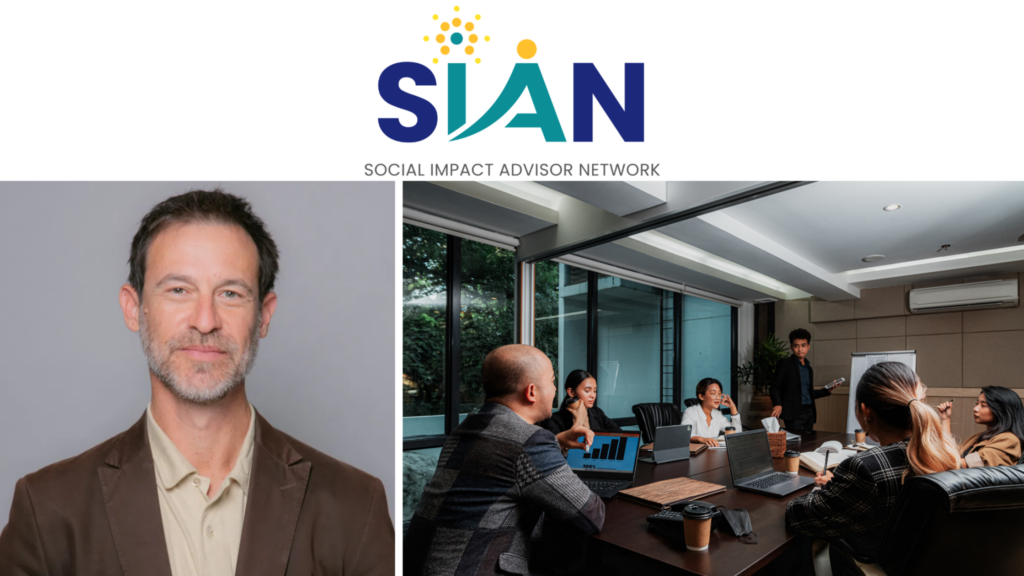
Reflections from Josh Leonard, CEO of East Bay Agency for Children
At a recent Social Impact Advisor Network (SIAN) monthly meeting, members heard from Josh Leonard, CEO of East Bay Agency for Children (EBAC). Josh’s remarks offered both a clear-eyed look at the realities nonprofit leaders are facing right now and a steady reminder of where meaningful impact still happens — locally, every day.
Who EBAC Serves — and Why Upstream Work Matters
Josh began by introducing EBAC, a 75-year-old Alameda County–based nonprofit that supports children and families impacted by trauma and social inequities. EBAC provides a wide continuum of services, many embedded directly in schools — where kids and families already are.
“We’re highly committed to creating accessible services,” Josh explained, noting that co-locating support in schools allows EBAC to “show up and identify issues of need and support them often before they develop into acute crisis.” That early intervention, he emphasized, makes their work more effective.
EBAC provides school-based therapy, special education support, after-school programs, family resource centers, and services for youth involved in or transitioning out of the probation system. In a typical year, the organization serves about 4,500 children and families, while reaching another 20,000 through food distribution, trainings, and other community-based supports.
Josh shared that this upstream focus comes from experience. Earlier in his career, he worked directly with youth exiting foster care and juvenile detention — work he cared deeply about, but that raised hard questions.
“I really loved that work and found it really righteous,” he said. “But… the outcomes were just terrible.” That realization pushed him toward prevention-focused models that help families avoid entering crisis-driven systems in the first place.
Navigating the Political Moment Without Losing Local Agency
A central theme of Josh’s talk was how nonprofit leaders process the current political and policy environment. Like many in the room, he closely follows national politics — budgets, elections, and policy shifts with real consequences for vulnerable communities.
“The stakes are very real,” he acknowledged. “Particularly for those of us who care about having a social safety net for the more vulnerable amongst us.”
At the same time, Josh shared a growing concern that constant attention to national politics can distort how leaders show up locally, sometimes giving federal dynamics “more weight in our day-to-day thinking than our actual ability to influence.”
That imbalance, he suggested, can be draining — and counterproductive.
“I find it more useful … to not get stuck in the things we can’t control and to really double down on the areas where we can make a meaningful difference in the lives of individuals in our own community.”
– Josh Leonard
What Showing Up Looks Like in Practice
Josh grounded these ideas with examples from EBAC’s day-to-day work. When CalFresh benefits were briefly interrupted late last year, many families suddenly couldn’t buy groceries. EBAC responded by quickly mobilizing partners and donors.
“We were able, as an organization, to tap into our stakeholders … and support people who were in acute crisis,” he said. While the policy problem itself remained unresolved, local action filled an immediate gap.
Looking ahead, Josh noted EBAC is preparing for potential fallout from changes to Medi-Cal and Medicaid — particularly administrative hurdles that could cause eligible people to lose coverage.
“We’re spending lots of time working with local government and internally … to figure out how we support people in navigating these arduous systems, so they don’t end up being kicked off the rolls.”
The underlying point was simple but powerful: “Families don’t experience systems — they experience whether someone shows up.”
Why Ecosystems and Relationships Matter
Josh repeatedly emphasized that EBAC’s ability to respond depends on its broader ecosystem. Board members, consultants, volunteers, donors, and professional partners all contribute more than they may realize.
“They often bring a different perspective … and insight into how other industries do things well,” he said. “They can make introductions. They bring tons of value to what we’re doing.”
He shared how one relationship — initially rooted in a discrete project — grew into ongoing introductions and support. For nonprofit-serving consultants in the room, it was a reminder that their influence often extends beyond a single engagement.
Growth Through Focus, Not Chasing Scale
During the Q&A, Josh was asked about EBAC’s growth. Over the past decade, the organization has roughly doubled in size — despite repeatedly stating in its strategic plans that growth was not a primary goal.
“Every time, we’ve said that growth is not a metric of success,” he shared. Instead, EBAC focused on its core competencies and where it could add the most value.
That clarity paid off. “Different schools and districts have seen what we’re doing and thought the investment is worth it,” Josh said, allowing EBAC to grow organically while staying focused.
The Power of Acting Locally and Proactively
Josh closed by pushing back against a question he often hears: “Isn’t this work depressing?”
“I think it’s just the opposite,” he said.
“Our ability to actually make a difference one person, one family at a time… that’s where the meaningful impact happens.”
– Josh Leonard
His invitation to the SIAN community was clear: national policy matters, but so does local agency. And our communities are only as strong as the people willing to invest their time, skills, and care close to home.
This conversation was part of a monthly meeting hosted by the Social Impact Advisor Network, where nonprofit leaders and advisors come together to share perspectives, deepen connections, and strengthen the ecosystem that makes this work possible.
This post originally published here.